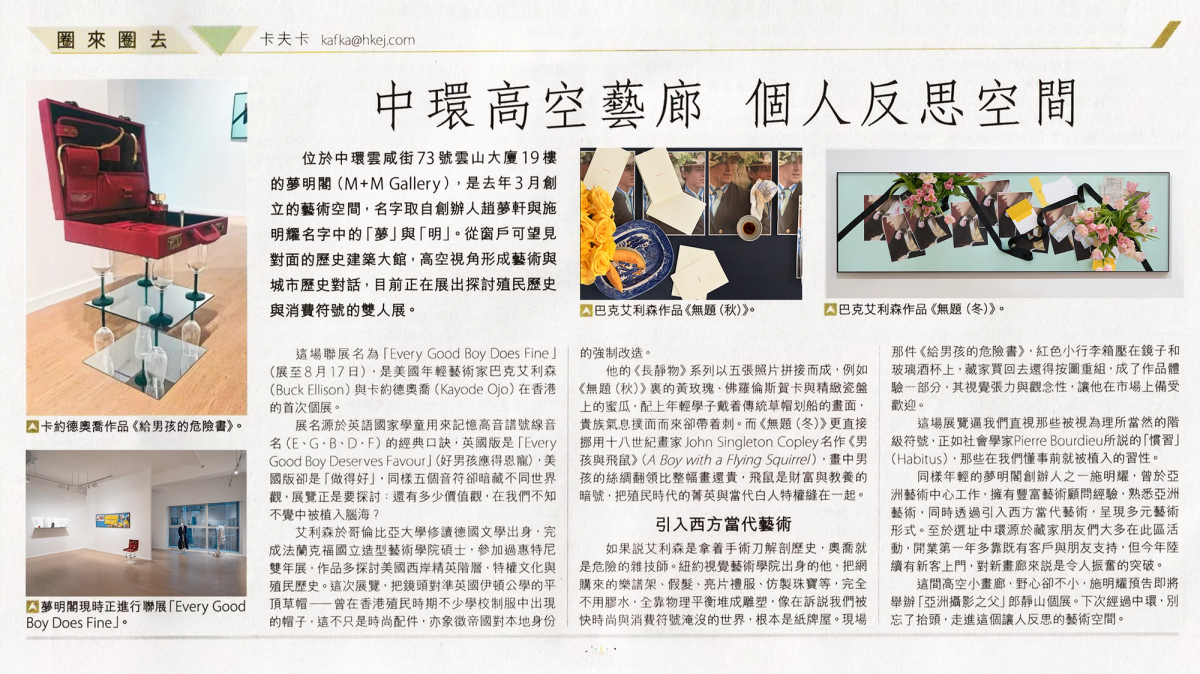
HKEJ Coverage |A High-Rise Gallery in Central: A Sanctuary for Inner Reflection
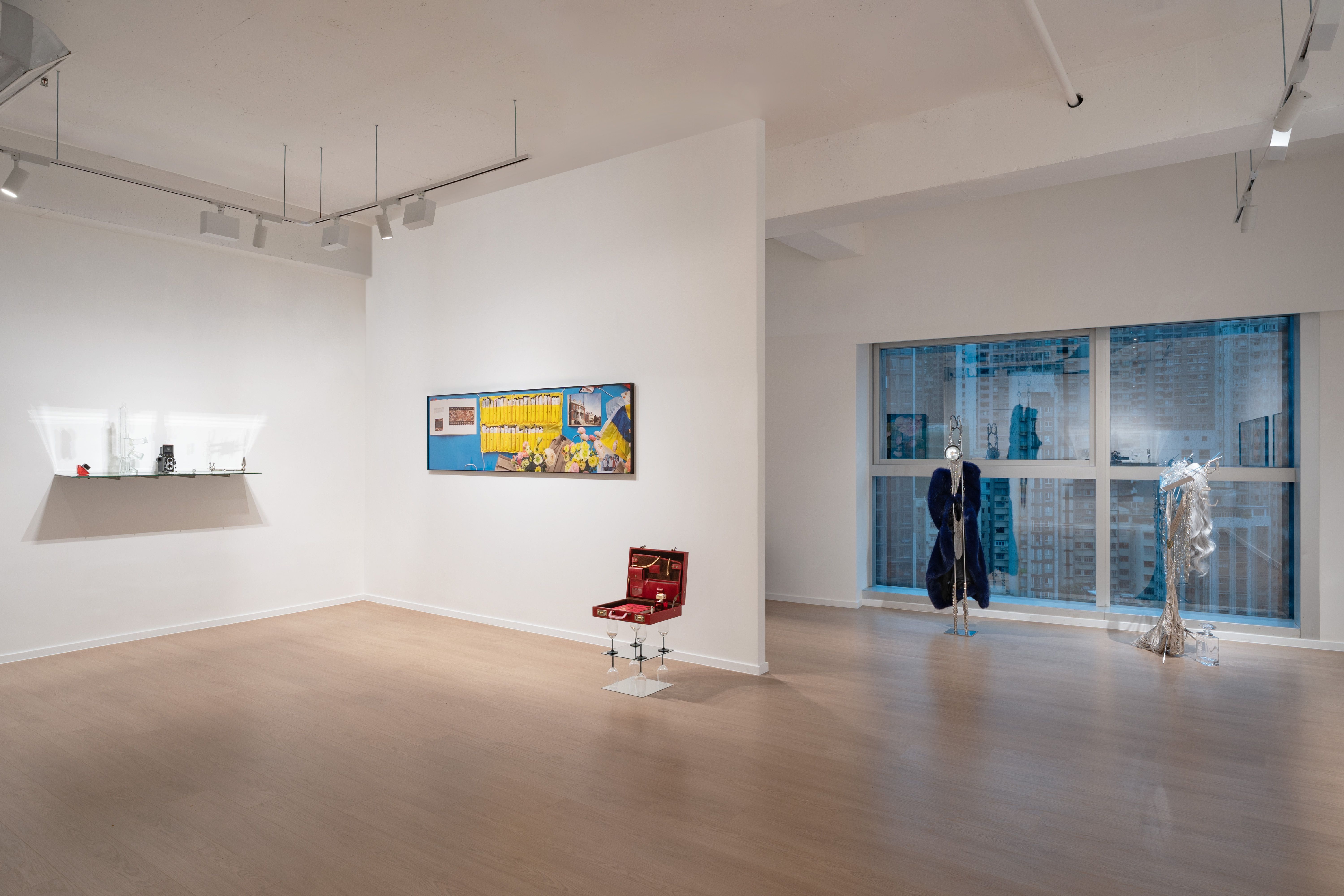
Co-presented by Buck Ellison and Kayode Ojo, the duo exhibition Every Good Boy Does Fine (on view through August 17) marks the artists’ debut presentation in Hong Kong.
The exhibition title stems from a mnemonic device commonly used in music education to memorize the treble clef staff notes (E-G-B-D-F). While the British tradition uses "Every Good Boy Deserves Favour," the American version shifts to "Every Good Boy Does Fine." This subtle linguistic difference reveals contrasting worldviews embedded within the same structure. The exhibition invites viewers to consider how many of our values are unconsciously internalized over time.
Educated in German Literature at Columbia University before completing his MFA at the Städelschule in Frankfurt, Ellison, a past Whitney Biennial participant, frequently examines elite culture, privilege, and colonial legacies in the American West Coast. In this presentation, he focuses on the traditional boater hat of Eton College, an accessory that was adopted into school uniforms during Hong Kong's colonial period. Rather than a mere fashion item, the headwear represents a tool for institutional influence and the shaping of local identity.
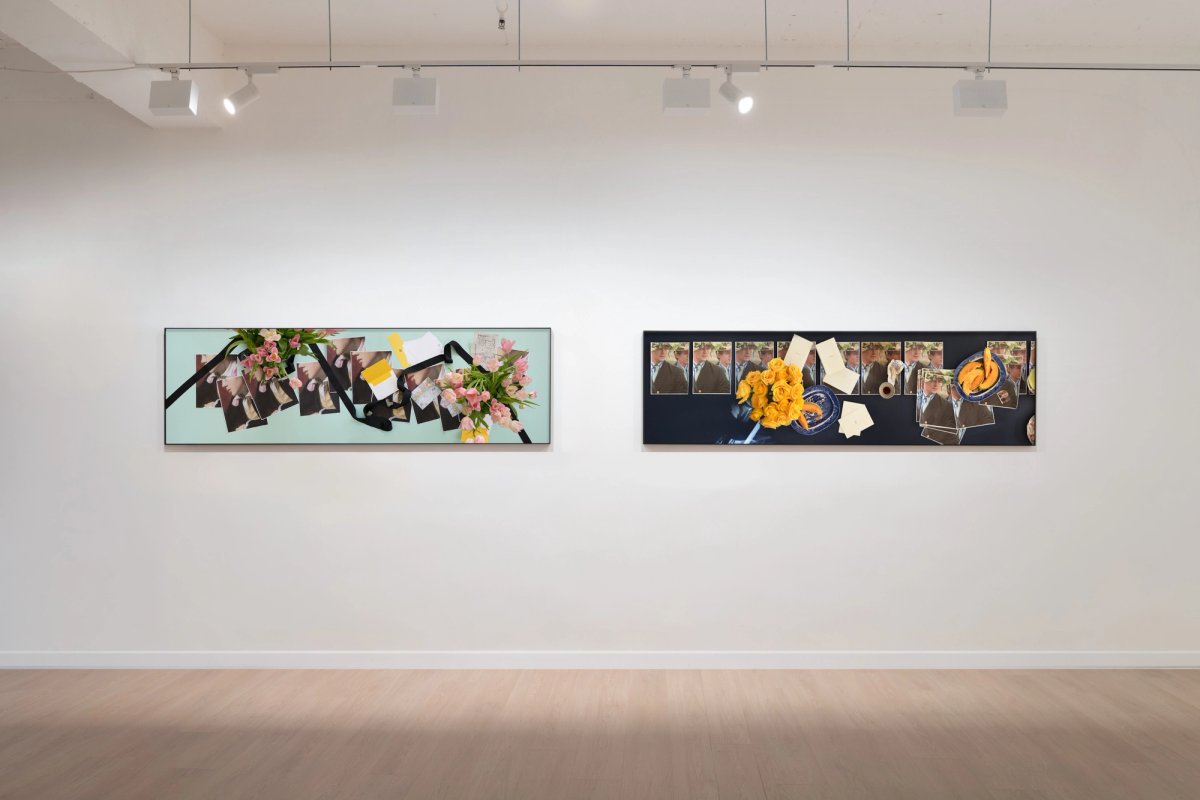
Ellison’s five-part photographic series, Long Still Life, explores this dynamic through contrast. In Untitled (Fall), symbols of domestic life, such as yellow roses, Florentine cards, and sliced melons on transferware plates, are paired with historical images of students rowing in classic boater hats, creating an aristocratic atmosphere with an underlying sense of critique. Untitled (Winter) directly references John Singleton Copley’s 18th-century painting A Boy with a Flying Squirrel. By drawing attention to details like the boy's fine silk lapel and the exotic squirrel as markers of status and upbringing, Ellison connects historical elite portraiture with contemporary privilege.
Introducing Western Contemporary Art
If Ellison analyzes history with precise observation, Ojo approaches his work through physical tension. A graduate of the School of Visual Arts in New York, Ojo creates sculptures by balancing everyday items, such as music stands, synthetic wigs, sequined dresses, and costume jewelry, entirely through weight and gravity without using adhesives. His work reflects on a society saturated with fast fashion and consumer symbols, suggesting a structure as fragile as a house of cards. In The Dangerous Book for Boys (Kingdom Hearts, HK), a small red suitcase rests precariously on a mirror and glassware. Collectors must reassemble the piece using a diagram, making the setup process an essential part of experiencing the artwork.
The exhibition prompts a closer look at the class symbols we often take for granted, recalling sociologist Pierre Bourdieu’s concept of Habitus, which describes the habits and dispositions ingrained in us before conscious awareness.
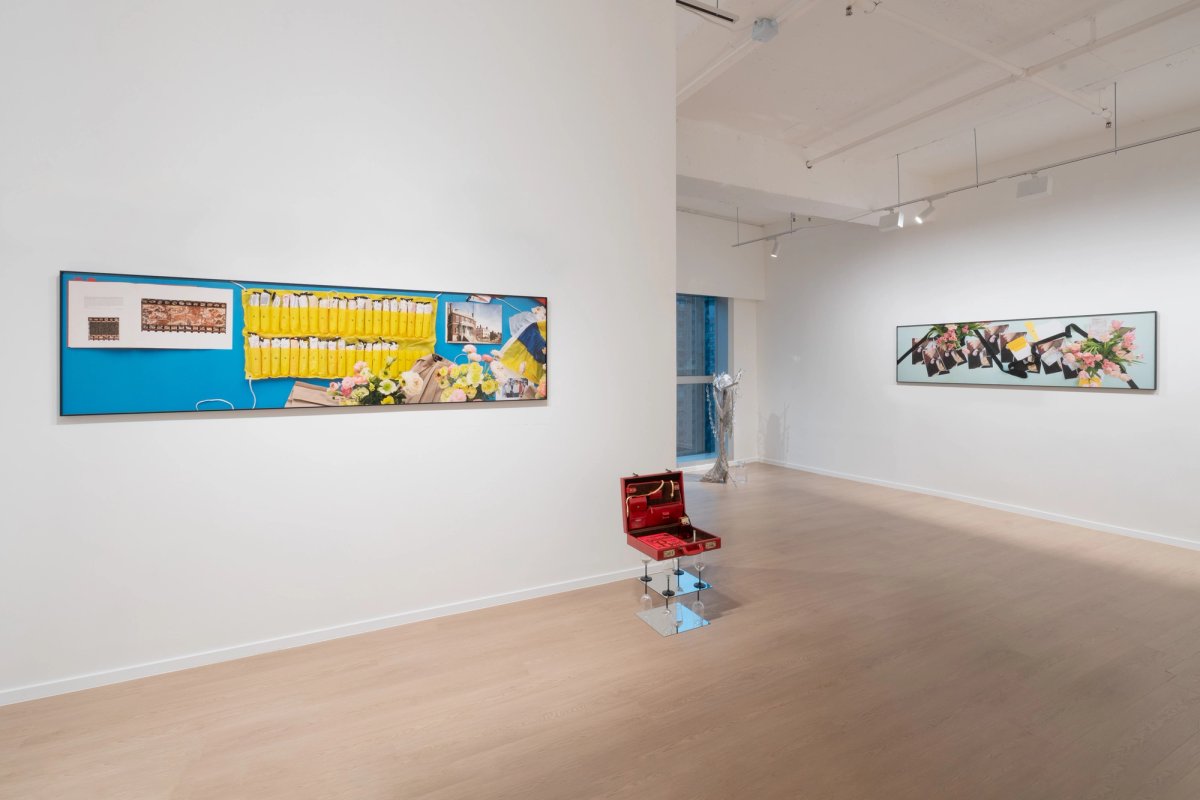
Shih Ming-Yao, co-founder of M+M Gallery, brings extensive advisory experience from his former role at Asia Art Center. Drawing on his background in Asian art while introducing Western contemporary practices, Shih aims to present diverse perspectives within the local art community. The choice of Central reflects the gallery's close connection to the regional collector network. Following a successful first year supported by established patrons, the gallery's growing audience marks an important milestone for the space.
Located above the city streets, M+M Gallery continues to pursue ambitious programming, including an upcoming exhibition dedicated to Lang Jingshan, a pioneering figure in Asian photography. High above Central, the gallery offers a quiet space for contemplation and dialogue.
2026 July 27
This text is translated from the original Chinese article published in the Hong Kong Economic Journal. Acknowledgments to the author and the editorial team.
Original link