Mary Corse
the United States
1945
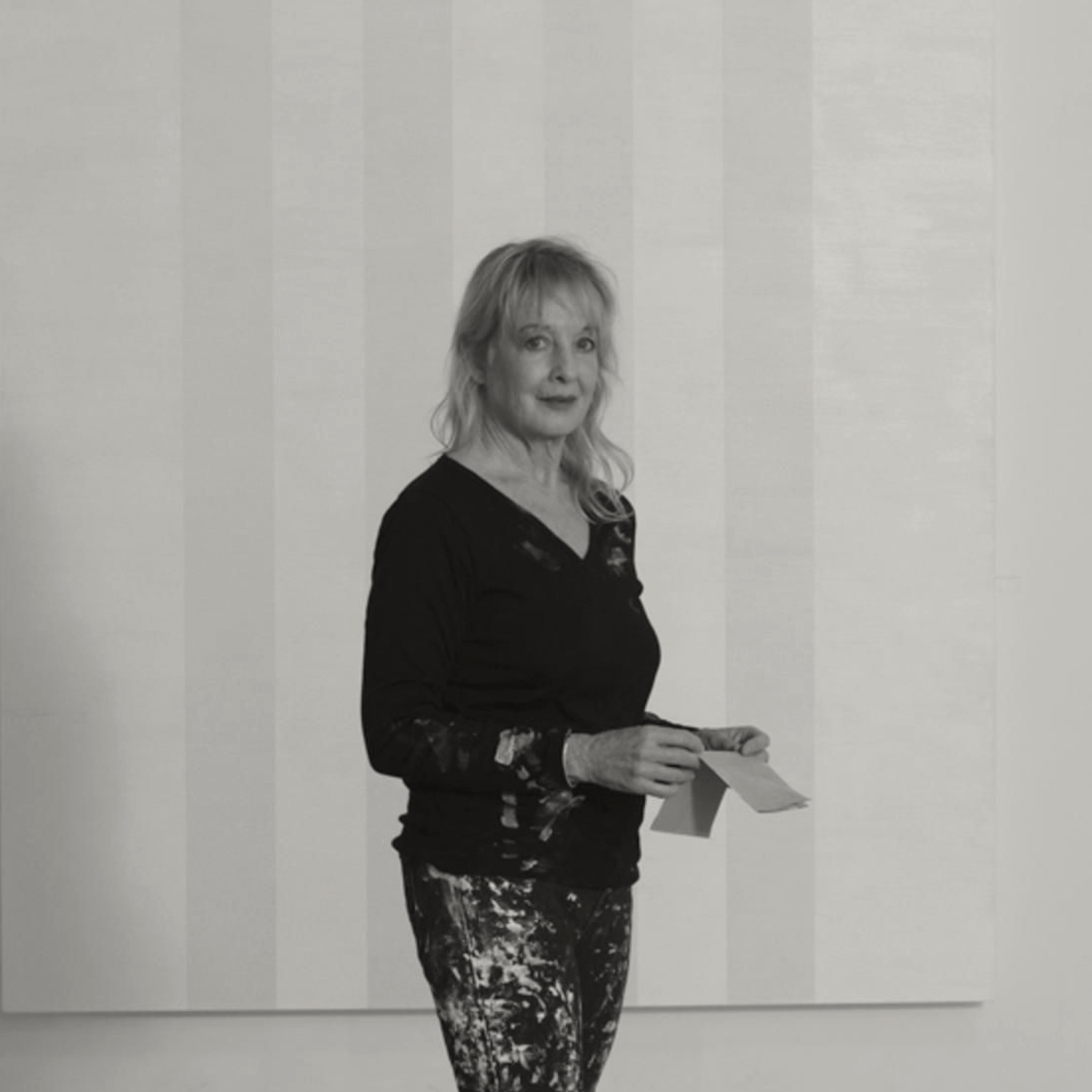
Mary Corse was born in Berkeley, California, in 1945. She lives and works in Topanga Canyon, Los Angeles. In 1968, she received her BFA from the Chouinard Art Institute, now the California Institute of the Arts. A rare female pioneer of the Light and Space movement, she was shaped by early training in painting and a sustained engagement with physics and quantum mechanics. These influences carried her work beyond the two-dimensional limits of traditional painting toward a perceptual experience grounded in light.
Her practice centers on light as both material and subject. In 1968, inspired by highway reflective markings, she began embedding glass microspheres into acrylic paint. As viewers move, these minute beads shift between visibility and glow, transforming the canvas into a field of energy and perception. In the late 1960s, she developed her White Light paintings; in the 1970s, she turned to the Black Light series; and in 1978, she began crafting large ceramic slabs for the Black Earth series. After three decades of monochrome work, she reintroduced primary colors in the 1990s, guided by the idea that white light contains all color. Through precise material control, Corse extends Minimalism's objectivity into a deeper inquiry into subjective perception and the limits of human vision.
Her first major museum retrospective, Mary Corse: A Survey in Light, traveled from the Whitney Museum of American Art, New York, to the Los Angeles County Museum of Art in 2018–2019. Her work is held in prominent collections internationally, including the Museum of Modern Art, New York; the Solomon R. Guggenheim Museum, New York; the Whitney Museum of American Art, New York; the Los Angeles County Museum of Art; the Museum of Contemporary Art, Los Angeles; the Dia Art Foundation, New York; the Long Museum, Shanghai; the Amorepacific Museum of Art, Seoul; The Menil Collection, Houston; and the National Gallery of Art, Washington, D.C.